
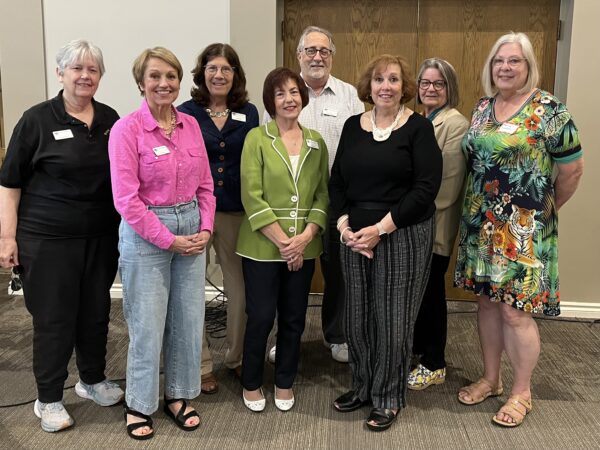
Eight LWVGP members attended the recent LWVUS National Convention in Columbus, OH.
Attendees included LWVGP delegates Lynne Pierce, LIz Martin and Deb Sloss.
Also attending were Sue Acton, Ray Andary, Judy Florian (LWVMI Delegate), Loren Mannino and Laura McCourt.
Our LWVGP attendees provided the following summaries.
Lynne Pierce
Introduction to Governance Non-profits are experiencing greater risk and scrutiny than in the recent past. We need to be legally compliant to protect our integrity and public trust. Our fiduciary responsibilities include a duty of care, loyalty and responsibility. The core compliance documents are all complete for our local league (IRS Form 990, Articles of Incorporation, IRS determination letter, and bylaws). A discussion was held regarding the importance of complying with our 501c3 status and the feasibility of establishing a 501c4. National resources were provided to assist us with this effort.
Unite & Rise Kentucky: Showing Up For Democracy in a Constitutional Crisis In Kentucky there are over 1000 ICE detainees held in county jails. The Kentucky League had to mobilize quickly to address this problem. If this becomes a problem in the Detroit area, we need to be ready to address it. Resources were provided to assist us. The importance of working with coalition partners was also stressed.
Gen Z x LWV This session was led by a young woman named Zoe Brookshire (LWV-Knoxville) who provided us with some great ideas on how to engage younger citizens. Gen Z is ages 14-29. Our goal is to find, foster, and promote young leaders. Zoe was recruited by a dedicated older member who mentored her along the way. She recommends offering paid internships to attract young people. These can be offered through Linked-In. GenZers have a high degree of social media literacy and use social media as their primary source of communication. Face Book is not used by young people. Zoe’s advice is to: listen, identify simple short-term goals, ask questions without showing skepticism of their ideas, speak the truth, embrace change, and focus on next steps. She cautioned that GenZers are quick to set boundaries and advised us to treat them with respect and be kind! Also, two young people talked about their podcast that can be reached through Facebook/LWV Knoxville. Most importantly, BE OPEN TO NEW IDEAS!
DEI Session (all attendees) The speakers discussed the four pillars of DEI: 1) Interpersonal challenges, 2) Decision making, 3) Community involvement, and 4) Leadership and training. This will be the focus of LWV for the next two years. We should be asking: 1) Who has the power and the resources, 2) Who benefits from the decision, 3) Who is harmed by the decision, and 4) What assumptions are we making?
Liz Martin
Why Should We Abolish the Electoral College? Part of the LWVUS Program: Women Defend Democracy*
Each of the three speakers at this session were from Illinois Leagues (Chicago, Wheaton, and Deerfield). They stressed that LWV has believed, since 1970, that the Electoral College (EC) should be abolished in favor of a direct popular vote. Their presentation identified a direct popular vote as the solution to three problems with the EC: 1. it allows a candidate with fewer votes from the people to win the Presidency (which has happened five times); 2. it has been shown to decrease voter turnout because of its heavy emphasis on “swing states” and the belief of voters in other states that their voices don’t matter; and 3. no matter how many people live in a state, the state gets two electoral votes based on its two senators, thus votes from smaller states weigh more, which violates the principle of “one person, one vote.” Local Leagues were encouraged to give the LWVUS slideshow (“Why We Should Abolish the Electoral College”) to groups in their local communities (e.g., Rotary, Kiwanis). This slideshow, which many of you may remember, was provided by LWVGP and the GPPL in cooperation with LWV Oakland earlier this year.
Attendees were encouraged to spread the word, in-person and/or through social media; host a presentation; and prepare to lobby Congress. To that end, the presenters were kind enough to give me 50 postcards to be written by individuals, not as representing LWV (although LWVUS has given permission for this project), which should be mailed after the newly elected Congress is seated in late January 2027.
*The League Program for 2026-2028 that was adopted at Convention is “Defending a Democracy Under Siege,” and replaces the previous Program, “Women Defend Democracy.”
How Passage of the National Vote Interstate Compact (NVIC) Will Help Fix Our Constitutional Crisis
This session was sponsored by NPV Network; the three speakers were from LWV Palm Beach, LWV Oregon, and LWV Wisconsin. The goal is to activate members to pass the NVIC in their states, thereby enabling the President to be elected by national popular vote in 2028 or 2032. Eighteen states + D.C. have joined the compact (for a total of 222 electoral votes), which is 81% of the total required to trigger the national popular vote; only 48 electoral votes remain to get the national popular vote. Michigan, with 15 electoral votes, has yet to join the compact. Attendees were encouraged to form an
NPV committee, educate their communities, write letters to the editor, visit and educate legislators, and don’t give up!
Organizing for Action/The Fundamentals of Organizing
Each of the three speakers were LWV regional organizers. The stated goal of the session was to introduce League leaders to the core principles of organizing and how to translate these principles into action; connect organizing concepts to the work they already do; and leave with practical ways to begin applying an organizing lens to strengthen engagement, leadership development, and impact in their communities. In addition to a slide presentation, each speaker related a personal anecdote to illustrate how they became organizers. While the speakers were highly motivated and energetic, to this attendee, the session offered an academic exercise in organizing rather than a practical approach in doing so.
Leadership Succession Planning
The Co-President of LWVMA was the sole presenter at this session, which focused on equipping Leagues with practical, adaptable strategies to intentionally prepare future leaders and implement meaningful succession planning at every level. Examples of strategies to prepare future leaders included demystifying the role by creating job descriptions that highlight actual time commitment; encouraging micro-volunteering; shadowing; and focusing on skill sets. In addition, at the hand-off (or onboarding) of new leaders, suggested strategies included an overlap period of the incoming and outgoing leaders; exit interviews; new leader orientations; introductions to key community stake holders; and setting 90-day goals to build early momentum. Attendees were provided a very helpful printed toolkit containing an Action Plan Worksheet.
Deb Sloss
The theme for the National LWV Convention in Columbus OH 6/25-6/28 was “Women Unite and Rise”. There were approximately 1,000 delegates both online and in person from 49 states and D.C.. The delegates had much work to do and the Plenary sessions were jam-packed.
Some of the motions passed in Plenary include Retaining all current LWVUS positions in the areas of representative government, international relations, natural resources and social policy; Defending a Democracy Under Siege which includes voting rights, protecting elections, redistricting Immigration, Individual Rights and the Presidency; Religious Freedom; Reaffirmed its commitment to nonpartisan civil service work; Supports a Statehood for the people of D.C.; Reaffirmed we are in a constitutional crisis; Supporting members advocating for the popular vote.
We had an inspiring speech (Prerecorded) from Lynda Bird Johnson Robb, sharing when she was 18 and the Voting Rights Act was signed into Law by Lyndon B Johnson in Congress. She recalled how so many people put their lives on the line to give others the sacred right to vote. She has long been a member/supporter of LWV.
There were breakout sessions where we could be in smaller groups. I attended Our Money System and the Democracy Crisis: The Case for a Study; Get Out the Vote; Unite and Rise: Showing up for Democracy in a Constitutional Crisis and Recognizing Harmful Norms in White-Dominant Spaces.
As Leadership mentioned time and again, the League is Grassroots, and that is its strength. I am honored to have been asked to attend, and have an opportunity to get to know other GP Board members. We have such a dedicated team with all of our league members and we will be setting out to implement some of our conference learnings. I’m excited for our future!
Sue Acton
LWV Washington reported on immigration. LWVUS added an immigration position statement at the convention this year. It was brought to the convention for concurrence by LWV Washington, voted and recommended by the LWV board, and approved by the delegates. This new position statement allows leagues at every level to advocate, lobby, and sue to protect the rights of our immigrant populations. Members of LWVW explained its history in their state.
Immigration Action Roundtable Discussion
LWV Edina, MN reported on ICE. Two members of this league discussed the trauma brought to Edina and the Twin Cities by ICE. Their league actively worked to support their immigrant neighbors and others targeted by ICE by bringing food to the homes of those afraid to leave them, by standing outside schools at the start and end of the school day to protect kids being dropped off, by passing out hundreds of “Red Cards” (the know your rights cards), and by joining protests. They reported that for every one person picked up with any sort of crime or infraction, twelve were picked up with no criminal record. They warned that ICE targeting can happen anywhere. Be prepared.
Partnering with the Girl Scouts: Guidance, Learnings and Best Practices
LWV Ohio reported on the LWV/Girl Scout partnership. Voter Girl, a member of this league, reported on the success of using their trademarked program, in partnership with Girl Scouts at all levels from Daisies through Ambassadors, to earn Democracy and Civics badges. They sell this program to leagues (complete with a red, white, and blue costume), but acknowledge that leagues can set up programs of their own either directly with local troops or by speaking with Scout leaders at the Council level who are well versed in this partnership. Badge requirements
Staff members of LWVUS discussed using social media and strong websites to convey our message to our members and the community. LWVUS is on most major platforms: Facebook, Instagram, Threads, and will return to X shortly, taking the position that it is prudent to know what’s out there, responding if necessary. They noted that content that is educational, human-centered, timely, and in short~form video draws the most views. Because of AI, websites need to be optimized for search (SEO), answer (AEO), AND generative (GEO) engine optimization. AI is looking for answers to questions users have. Our website needs to provide answers with less emphasis on keywords but more emphasis on detail AI might pick up.
Loren Mannino
I attended the Convention in Columbus Ohio as an Observer for LWVGP. As such I did not participate in the Plenary voting sections, but did attend several breakout sessions as well as the presentation on DEI issues. This report focuses on the breakout sessions, although the DEI presentation was excellent and a real eye- opener.
Our Money System and the Democracy Crisis: The Case for a Study
This session was presented in support of a proposal on the Convention agenda to authorize a national study on the merits of restructuring the way the money supply in the economy is structured. Briefly the idea is to limit the role of financial institutions to create money by issuing debt, and have the government issue money as the need arises. I have attached two of their handouts which will explain their proposal better than I am able. Variations of this proposal have been around since the 1920s.
The members in the Plenary session voted down the proposal to authorize a study of the issue. The two main arguments raised against it were that it was utopian in nature, and second was that there were more pressing issues for the League due to the constitutional crisis. The latter argument was typically expressed as “the house is on fire”. The members promoting this proposal are very determined and I suspect we will see this issue raised again in the future.
Immigration Action Roundtable Discussion
This session was focused on connecting members with resources for opposing ICE’s many abuses, and on useful suggestions from the panel, all of whom are active ICE opponents in their jurisdictions. Coming the day after the United States Supreme Court empowered the President to end TPS (Temporary Protected Status) for Haitians and Venezuelans it had aspects of a “primal scream” by the 1 dedicated roundtable members. They praised the toolkit on the National league site and emphasized that opposing ICE is too big of a task for a local league alone and strongly suggested an emphasis on coalition building for these efforts. A copy of their handout is attached with many useful suggestions for action.
Different jurisdictions present different challenges for this work. Texas for example has a statute requiring police departments to enter so-called 287 agreements with ICE, mandating cooperation. Jurisdictions like Houston are forced to walk a delicate line between that law and their own unwillingness to help these atrocities.
And atrocities they are. It was pointed out that in 85% of the arrests in Chicago’s “Midway Blitz” operation the immigrants had no criminal record!. They also suggested a necessity for humanitarian efforts to help people being released from detention, who are often put on the street far from home with no help or transition support from their captors. At the time of the session no one knew what was going to happen to the people formerly protected by the TPS orders. All in all it was an emotional session for all attending.
Building Partnerships to advocate for Ranked Choice Voting in Local Elections
This breakout session took a different approach than I had been expecting. Rather than focus on the sometimes complex aspects of a ranked choice system, the presenters focused on how to make progress in enacting it.
First they referenced the League’s positions on supporting voters rights, and despite their being no specific position on ranked choice they asserted that the language of the position would encompass promoting this voting system.
They suggested promoting ranked choice as a system where the winner has majority support, as opposed to fragmented races where the “winner” sometimes has only a small plurality and the majority of voters have voted against the proclaimed “winner”.
They also pointed out that in elections where the voters are choosing multiple members of a board, council, or the like, ranked choice can have the effect of, at least roughly, of electing members representing the various voting blocs in the voting population.
It was also suggested that this system might be a buffer against the ill effects of the recent Supreme Court decisions which effectively allow racist legislatures to eliminate “preference” districts designed to assure minority representation.
In pursuit of these goals they pointed out that while it is important to build local support, change in this area is required at the state level. They suggested that the League could provide research, speakers, and by lobbying legislators. They strongly supported coalition building, and recommended Fairvote.org as a helpful resource.
Defending Democracy in Your Community with LWVUS Advocacy Tools
This session was conducted by the leaders of the Federal Judiciary National study from last year and focused on their process and what lessons they drew from it. It may have been more useful to those working at the state or national level, but there were useful suggestions for local study groups.
At this level they required that prospective group members apply for admission complete with an essay! Once selected they suggested that with the resources of the internet, including artificial intelligence, the time required for studies could be considerably reduced. There was discussion about the benefits and dangers of using Al, and the panel members felt that the Claude system was the most useful and reliable in their experience.
They pointed out that the position defined from the study should be as general as possible to give individual leagues the ability to adapt it for use in their states and communities while still providing useful boundaries and guidance for advocacy of the position, and also so it will stand the test of time.
Conclusion
Getting to see the strength and passion of the delegates for the fight to preserve our democracy and rights was inspirational, and I got to meet countless remarkable women (and a few men!) who are putting their considerable intelligence and will toward these goals. I learned, got ideas, and considerable inspiration for myself to carry on this critical fight.
Laura McCourt
THE ALPHABET SOUP OF FUNDRAISING-DAFs, QCDs AND MORE
I discovered the definition of a DAF (donor adjusted fund) and QCD (qualified charitable donation). My main takeaway from the session: the LWV thankfully has members who are committed and knowledgeable in this area. The talk was on a level that my time was spent listening and absorbing as much as I could.
OBSERVER CORPS: ACCOUNTABILITY IN ACTION
Thanks to the training I have received as a junior member of the Observer Corps., much of the information in this group presentation was already known to me. The session included a definition of the OC, the role it plays in the community, and tips for Observers in action at meetings. The program emphasized the importance of recruiting new members, then engaging and empowering them. Retention of Observers was also discussed. It was noted that 38,750 Observers nationwide donated 900 plus hours towards League activities. Finally, in addition to recruiting and retaining Observers, the importance of Showcasing Success was emphasized.
A final, interesting comment, from the panel: one club occasionally turns a regularly scheduled League meeting into a “field trip” to a public meeting. This affords the Club a first hand experience in civic engagement and encourages participation in the OC.
UN OBSERVER ADVOCACY: HOW LWV IS ADVANCING CHANGE IN A RAPIDLY EVOLVING WORLD
Although I have visited UN Headquarters in New York City, I realized during this presentation that 1. I know very little about the activities of the UN 2. The UN is virtually absent from current media coverage in the U.S. This session was underwritten by an NGO (not part of the diplomatic corps) that has no budget.
The CEDAW (Convention on the Elimination of Discrimination Against Women) is a UN initiative that was highlighted during the session. It was described as a data driven initiative that reviews international goals in this area. The U.S. is one of 6 countries in the organization that has not ratified this Convention. The LWV does have a position on human trafficking, one of the elements in the CEDAW.
The presenters noted there is a 2 week meeting on the status of women, scheduled in NYC.
Another area of discussion was UNFCCC (United Nations Framework Convention on Climate Change).
The most important information I took away from this session was learning that http://webtv.un.org is available to everyone. It’s content includes past, present, and future work at the UN. I have viewed it since the breakout session and find it interesting and illuminating.
RECOGNIZING HARMFUL NORMS IN WHITE DOMINANT SPACES-AND HOW TO INTERRUPT THEM.
This session was, by far, the most useful and interesting presentation of the breakout sessions I attended. It was immediately followed by a one hour Diversity, Equity, and Inclusion (DEI) session to the convention at large. The high points follow:
- Race is a social construct
- Culture reflects the beliefs, values, norms, and standards of a group 3. We are taught overtly, and covertly, that whiteness denotes superiority 4. Our institutions, and culture, supports white culture
- View the film “Crip Camp”
- Practice compassionate self-assessment
- Avoiding shame is a major impediment to overcoming white supremacy 8. Read Layla Saad’s ME AND WHITE SUPREMACY
- Look up and study the Johari Window model
The section of the program, “Creating Partnerships” especially resonated with me. Focusing on how to create diversity, the panel suggested:
- Select the right venue
- Make the activity free
- Obtain input from the people you want to have attend your event